
Dosimeter and Survey Meter: One Keeps the Ledger, One Reads the Room
A little badge stops no radiation, so why wear it? And why does a handheld meter show nothing in the X-ray room? Two classes of instrument: one is sent away and comes back as a report, the evidence statutory monitoring accepts; the other counts in real time and alarms, your own self-check tool. Here is the difference, the two traps almost everybody falls into, and the five jobs a meter is genuinely good for.
 Veterinary imaging · Core software built in-house
Dosimeter and Survey Meter:
One Keeps the Ledger, One Reads the Room
A little badge stops no radiation — so why wear it? And why does a handheld meter show nothing at all in the X-ray room? Two questions, two different classes of instrument, two different jobs.
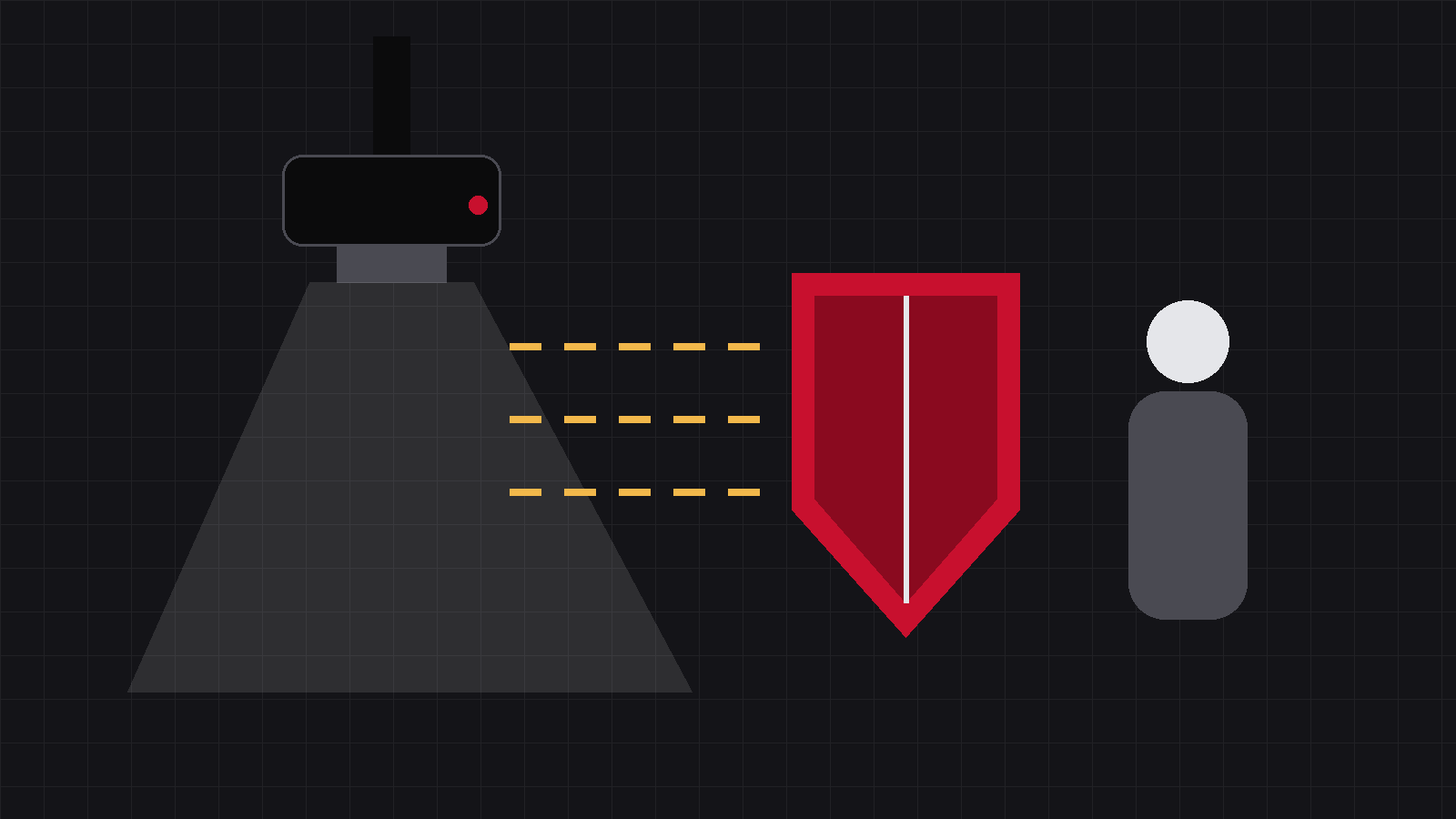
Two questions tend to arrive together. First: the licence paperwork says we need \“personal dose monitoring\“ — is that just a formality? A little badge stops no radiation, so why wear it? Second: we bought a handheld radiation meter, walked around the X-ray room with it, and the reading never moved off 0.1-something. Is there no radiation, or is the meter broken? Behind those two questions are two different classes of instrument.
01One sentence to separate them
One keeps the ledger; one reads the room.
Personal dosimeter (TLD)
The kind you send away to be read. It displays nothing at all; at the end of each period it goes back to an accredited laboratory and comes back as a report. This is the evidence that statutory monitoring accepts.
Electronic meter
Has a screen and starts showing numbers the moment you switch it on. Two shapes: worn on the body it is an electronic personal dosimeter; carried in the hand it is a survey meter. This is your own working tool.
Evidence and tool — neither substitutes for the other. Taking them in turn.
02First half: the dosimeter stops nothing; it keeps a ledger
It genuinely provides no shielding. Its job is to turn “I probably haven’t had much” into “here is exactly what I received this year, in writing.”
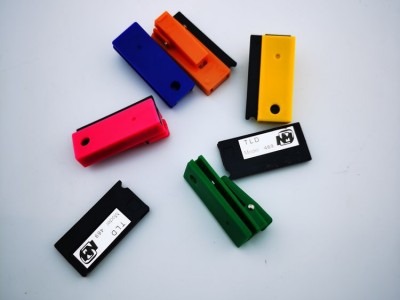
Where to wear it
The standard position is on the front of the trunk, typically at the left chest or collar. If you work in a lead apron, the dosimeter goes underneath the apron — what you need on record is what your body actually received, not what was present in the room.
How often is it read
Monitoring regulations set the routine period at one month, and no longer than three. In practice the laboratory sends fresh badges out and you send the used ones back, building a continuous record.
Reading the numbers
The occupational limit, averaged over five consecutive years, with no single year above 50 mSv; for members of the public it is 1 mSv per year. In a properly run veterinary clinic, annual readings for imaging staff sit far below the limit — for many people the badge comes back at close to background, reported as “not detected”.
If a reading is suddenly high
Do not panic, and investigate the badge before you investigate the person: was it left in the X-ray room? Did it travel through an airport scanner in someone’s luggage? Was it stored near another source? A dosimeter records its own exposure history — including whatever happened while it was away from you. Once those are excluded and the reading is still abnormal, then go to the rota and look at technique.
03Second half: the meter issues no evidence; it gives you a number now
This class of instrument fits in a palm, has a screen, and starts counting the moment it is switched on. Understanding it starts with understanding the numbers on that screen.
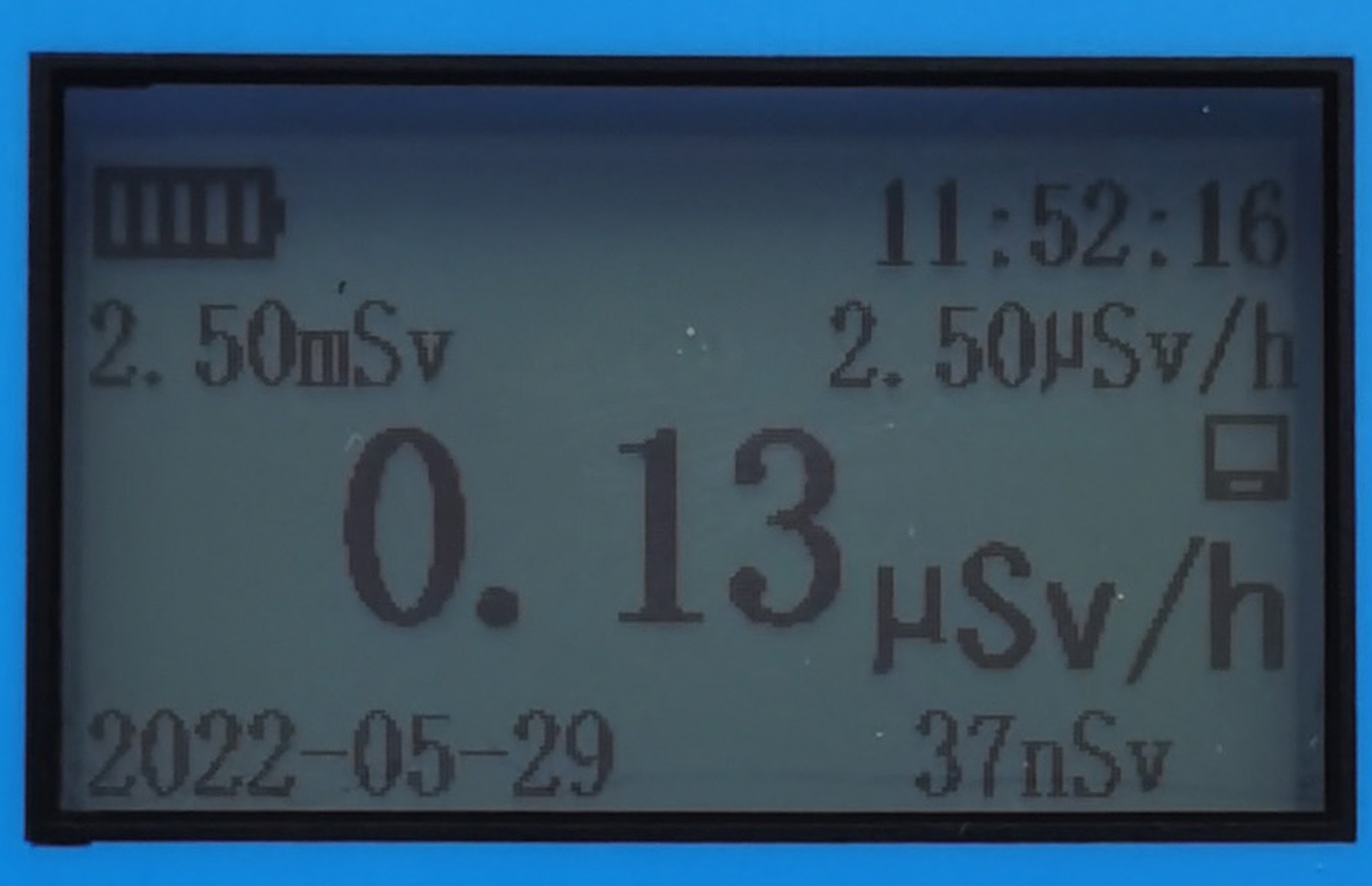
With a slash, it is a dose rate (μSv/h): how much you would receive if you stayed here for an hour. It changes in real time as you move and as the machine does or does not expose.
Without a slash, it is an accumulated dose (μSv or nSv): how much has arrived since switch-on. It only ever goes up.
One is a speedometer, the other an odometer. Everything issue 3 said about units can be checked off against this one screen.
Two of the numbers are usually alarm thresholds, one for rate and one for total, which sound when exceeded. Those are values somebody set, not values the instrument measured — do not confuse them.
04Two traps almost everybody falls into
Trap one: an idle X-ray room measures as nothing
Walk around the room with a meter and the reading sits at 0.1-something and never moves. Many people conclude either “there is no radiation in our room” or “this meter is faulty”. Both conclusions are wrong.
X-rays are a switch, not a battery
When the machine is not exposing, there is nothing in the room to find. That 0.1 μSv/h is natural background — you get the same on a hillside, in the street, or in your living room. Measuring radiation in an idle X-ray room is like measuring the brightness of a lamp that is switched off.
Trap two: a single exposure is too short for the meter to react
An exposure usually lasts tens of milliseconds, while most handheld meters take somewhere between a fraction of a second and several seconds to respond. The radiation has come and gone before the number starts climbing. So you press the switch, nothing happens on the screen, and you reach the same wrong conclusion again.
The correct method is to make the radiation continuous. On a machine with fluoroscopy, run the fluoro mode; with static radiography only, take repeated exposures at short intervals under safe conditions and read the total on the meter’s cumulative mode rather than watching the instantaneous value. Have your inspection body or an engineer walk you through it once on site rather than experimenting alone in the room.
05What it is actually good for: five real jobs
① Finding leaks in your shielding
Issue 13 listed four weak points: the door seam, the viewing window, service penetrations through walls, and the floor and ceiling. A meter is how you go over all four — run it along the door seam, and wherever the reading jumps is your leak.
② Self-testing after building work or moving the machine
Failing the official test means rework, and rework is expensive. Knowing where you stand beforehand beats finding out on the day the inspector arrives.
③ Turning “step back” from a principle into a number
Issue 4 explained the inverse-square law. Take a reading at one metre, take another at two, and your staff understand it at a glance — better than explaining it ten times.
④ Answering concerns on the spot
When a staff member is worried, an owner asks, or a colleague is sceptical, measure it in front of them. There is no more persuasive communication tool.
⑤ Re-checking after service work
A replaced tube, an adjusted collimator, filtration removed and refitted (issue 17) — measuring beats trusting.
06How to choose, and two things that must be said plainly
Three things to look for: first, energy response that covers diagnostic X-rays — diagnostic beams are relatively low energy and a plain Geiger tube responds poorly across that range, so choose an energy-compensated tube or a scintillation detector; second, a cumulative mode, not just an instantaneous readout, for the reason given above; third, settable alarm thresholds.
It does not replace statutory testing
Official testing means an accredited body, a calibrated instrument, a defined measurement layout and a formal report. Your own meter is a self-check tool, not compliance evidence — the relationship is that of a home thermometer to a hospital laboratory result.
Your own meter needs calibrating too
Meters drift. An uncalibrated reading is an indication, never a conclusion, and the instrument should go for periodic calibration in line with local metrology requirements. An instrument that has run five years without calibration can mislead you more than taking no reading at all.
07What using both together looks like
Put them on a timeline and it falls into place:
During construction and commissioning, the meter cleans up the room — is the shielding adequate, where are the leaks, where should the operator stand. That is prevention, in advance.
During day-to-day running, the dosimeter keeps the ledger on people — what did the person doing the restraining actually receive this year, is it time to rotate the duty. That is verification, after the fact.
When something looks wrong, read them together: an abnormal dosimeter result sends you into the room with the meter to find the cause — failed shielding, wrong standing position, or somebody’s hands going into the field.
Issue 8 argued that the person doing the restraining receives the most in the building. Whether that is a feeling or a fact, only the dosimeter can answer — and why it is happening, only the meter can show you on the spot.
One keeps the ledger, one reads the room.
An idle X-ray room measures as nothing — that is not an absence of radiation, it is an absence of exposure.
Source:Occupational dose limits (20 mSv/year averaged over five years, no single year above 50 mSv) and the public limit of 1 mSv/year — ICRP Publication 103 (2007), adopted in national regulations including China’s GB 18871-2002; monitoring periods (routine one month, maximum three) — China’s GBZ 128. The distinction between dose rate and accumulated dose is covered in issue 3 of this series. Calibration intervals follow local metrology requirements. Statutory testing must be performed by an accredited body; the self-check methods described here do not constitute compliance evidence.
IWA Medical · We build DR systems and write our own core software
Questions about veterinary DR imaging? Technical questions go straight to our engineers.
[…] same distinction sorts out the two instruments. Issue 7 covered them: a personal dosimeter monitors a person — you wear it, and at the end of a quarter […]
[…] last note: issue 7 made the case for re-measuring a room with a survey meter after any service. A machine whose […]