You Can X-ray a Phone Through a Lead Apron. Does That Mean the Apron Is Useless?
Put a phone under a lead apron, expose it on a DR system, and the phone shows up in perfect detail. So was the apron doing nothing? No. The apron removes most of the quantity of radiation; the detector and software stretch the little that gets through into a clear image. Whether an apron works is answered by a dosimeter, not by a picture.
 Veterinary imaging · Core software built in-house
You Can X-ray a Phone Through a Lead Apron.
Does That Mean the Apron Is Useless?
Put a phone under a lead apron, expose it on a DR system, and the phone shows up in perfect detail. So was the apron doing nothing? No. The apron removes most of the quantity of radiation; the detector and the software then stretch the little that gets through into a clear image. Whether an apron works is answered by a dosimeter, not by a picture.
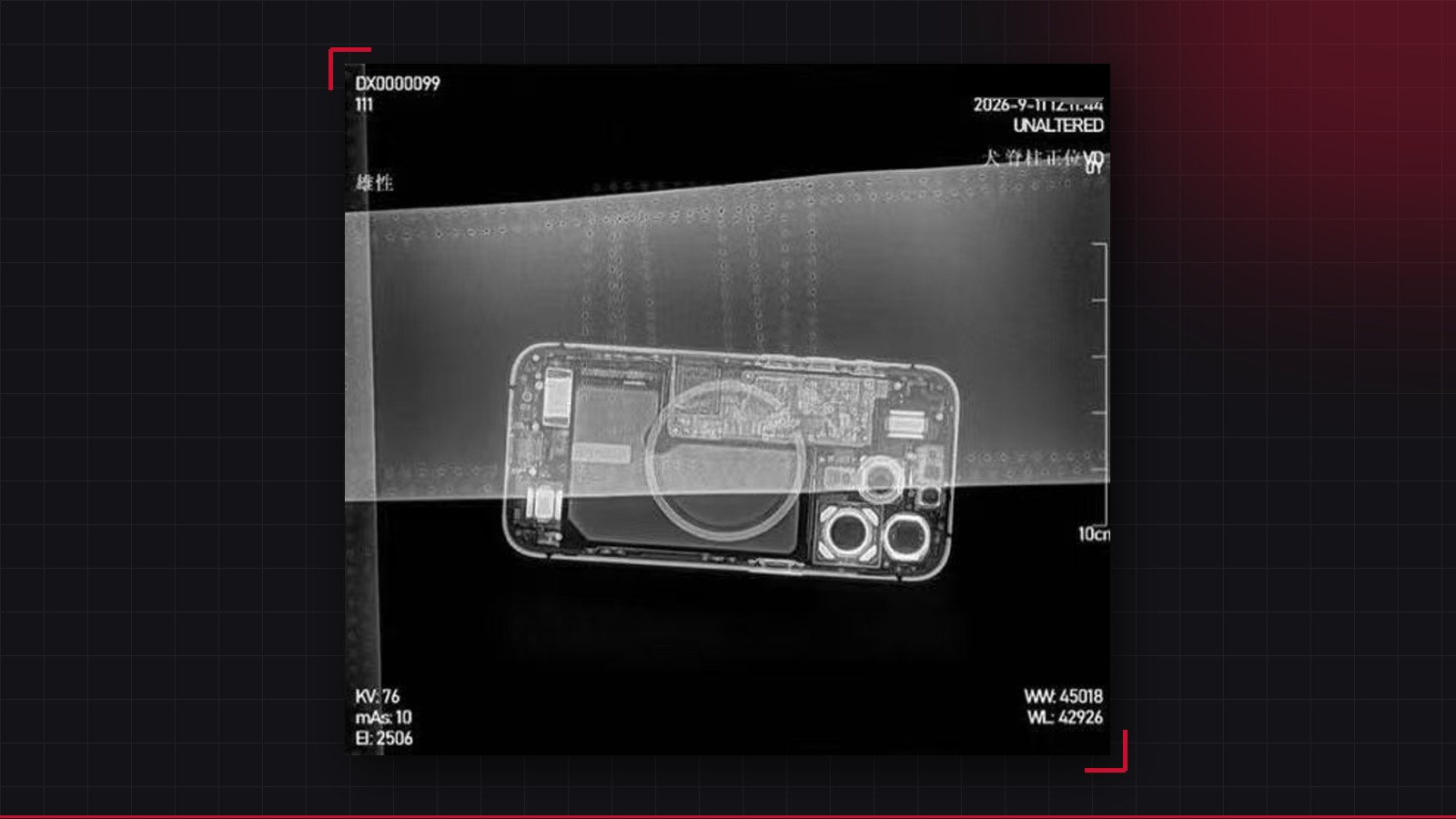
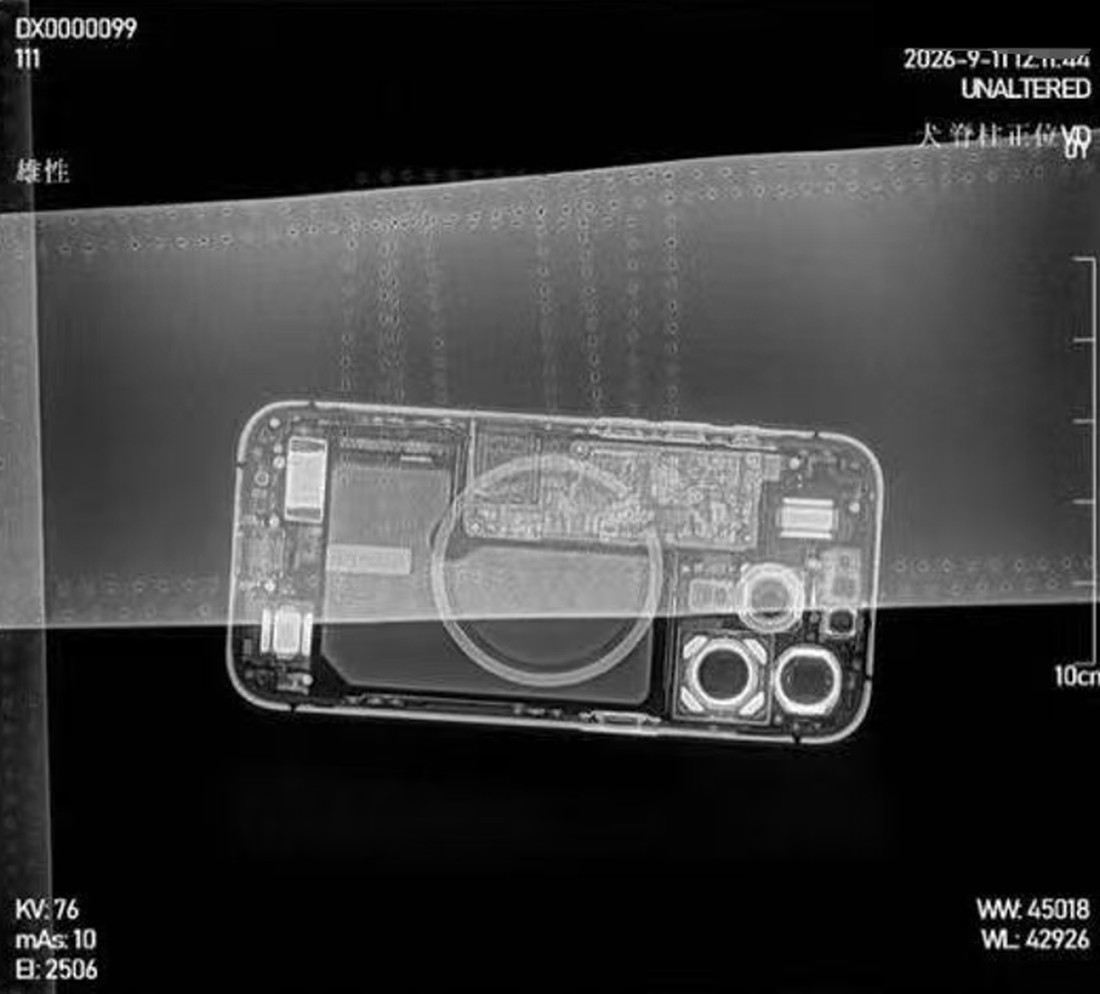
A short video did the rounds among veterinary staff this week. Someone laid a phone on the detector, covered it with a lead apron and pressed the exposure switch. The image showed the phone’s mainboard, battery and camera module, every trace visible. Their conclusion: the apron does not stop X-rays, so wearing one is pointless. Quite a few people in the comments panicked. Our short answer: the experiment was done right; the conclusion was wrong. The apron is not useless — this image simply cannot tell you whether an apron works.
01An apron reduces the amount, not the image
A lead apron’s job is to cut the radiation passing through it down to a small fraction. For the lead equivalence typically used in veterinary clinics, at seventy-to-eighty kV, only a few percent gets through. In other words, the apron keeps the vast majority of the beam out. That is its job, and it is the whole of its promise.
To keep most of the radiation out
Only a few percent gets through. That is what “protection” means: bringing the amount down to very little, not to zero.
“Not a single photon gets through”
Nothing wearable can do that. Stopping the beam completely would need lead far thicker than any apron — and nobody could wear it.
So the real question becomes: why do those few percent still produce such a sharp picture of a phone?
02Because a DR system is a camera with night mode permanently on
A modern phone camera has a night mode that takes a clear photo in a nearly dark room. The room is not actually bright; the sensor is sensitive enough, and the software then brightens and stretches the faint signal it received.
A DR detector is exactly that kind of sensor. It can distinguish tens of thousands of grey levels, while the human eye sees a few dozen in any one image. So after the exposure, the software does one thing: whatever signal it received, weak or strong, it stretches it to fill the range you can see. If only a few percent of the beam comes through the apron, the software displays those few percent as 100%. The phone looks sharp, yet the detector received only a small fraction of the usual radiation.
An image shows contrast; dose is quantity
Neither tells you about the other. You can see the road perfectly well through sunglasses — that does not mean the sunglasses block no light. They block most of it, and your eyes amplify what is left.
Look at one more detail: the rows of tiny stitching dots on the apron are visible in the image. That shows how sensitive the detector is — and it shows that the apron itself is “seen through” in the picture. It reduces the amount, not the image.
A phone is also an unusually easy object to image. Metal, battery, chips — its own contrast is enormous, so its outline jumps out even with very little radiation. Replace it with a slab of soft tissue and, under the same conditions, you get a field of noise.
03It was actually a good experiment — they just looked at the wrong thing
Imaging an apron on your own machine is a recognised way of inspecting it every year; we covered it in issue 5 of this series. What you look for is not “can I see what is under the apron” but whether the apron itself has cracks, dark lines or dark spots. The lead rubber inside cracks when it is folded too often; you cannot see that from outside — only an image shows it.
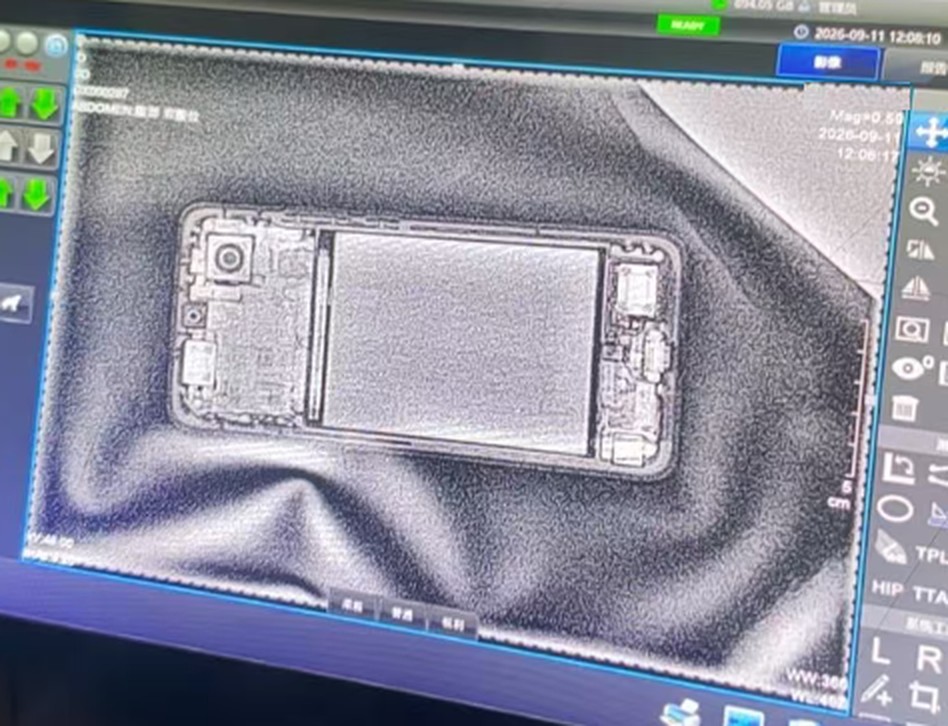
In the video, the apron area was uniformly grey with no visible cracks. From an inspection point of view, that apron passed.
04Whether an apron works: read the dosimeter, not the picture
There is only one reliable way to know whether an apron is doing its job on your body: a personal dosimeter worn underneath it. It is read out every quarter, and what comes back is a number.
The occupational dose limit recommended by the ICRP and adopted in most national regulations (averaged over five years). For staff taking static radiographs in a veterinary clinic with proper protection, the annual reading is usually very low — nowhere near this line.
One more thing the video left out: in the experiment the apron sat directly in the primary beam, whereas at work you receive scatter. The primary beam is aimed at the animal; a person standing a metre away receives radiation scattered off the animal, which is far weaker than the primary beam — by orders of magnitude. That scatter then passes through the apron, and again only a few percent remains. Stack the two, and what a person inside an apron receives is several orders of magnitude below what the animal receives. That is why the dosimeter shows so little over a whole year.
05About the medical test result mentioned in the video
We are not physicians and cannot judge anyone’s health. Only three things can be said:
① That test is a routine item in occupational health checks for radiation workers; the result has to be interpreted by an occupational
physician against the laboratory’s reference range, together with the person’s dose records;
② Many things move that number — age, smoking, infections, chemical exposure, and the test method itself;
③ A single number does not establish a cause, and a radiograph of a phone establishes even less.
If you feel unwell, see a doctor first — and bring your dosimeter records with you.
06If someone really is receiving too much, the apron is rarely the reason. These five are
Almost every case we have seen of imaging staff receiving more than they should comes down to one of these:
Hands inside the field, holding the animal
A hand in the field receives the primary beam — far more than scatter at the side of the table. The apron does not cover hands.
No thyroid collar
The apron’s neckline does not cover the throat, and scatter off the animal comes out at exactly thyroid height.
The same person always restrains
They are present for every single exposure. Over a year, one person can accumulate more than the rest of the clinic combined.
Aprons stored folded
The lead rubber cracks along the folds. You cannot see it — only an image of the apron shows it.
No dosimeter at all
Without a number, “too much” and “fine” are both just feelings, and nobody knows whether the protection is working.
Every one of these matters more than switching to a thicker apron.
X-rays are not to be feared. They are the most predictable thing in the room: they can be calculated, shielded and distanced. What should worry you is protection applied in the wrong place — followed by the feeling that “it doesn’t work anyway”.
An apron reduces the amount, not the image.
Whether it works, the dosimeter tells you — not the picture.
Source:Occupational dose limit of 20 mSv/year averaged over 5 years — ICRP Publication 103 (2007), adopted in national regulations including China’s GB 18871-2002. Apron transmission varies with tube voltage and lead equivalence, and scatter intensity with kV, field size and patient thickness; this article keeps both strictly qualitative and quotes no specific ratios. Imaging aprons annually to check for cracks is standard practice. Both radiographs were reproduced on our own equipment (0.35 mmPb apron) with facility information removed; this article does not evaluate any apron brand.
IWA Medical · We build DR systems and write our own core software
Questions about veterinary DR imaging? Technical questions go straight to our engineers.