
Standing One Metre Outside the Door: Is That Enough?
Stepping back works far better than you would guess — double the distance and the dose drops to a quarter. But where you stand matters more than how far. Three questions to check, and three zero-cost habits.
 Veterinary imaging · Core software built in-house
Standing One Metre Outside the Door:
Is That Enough?
Stepping back works far better than you would guess — double the distance and the dose drops to a quarter. But where you stand matters more than how far. Three questions to check, and three zero-cost habits for tomorrow.
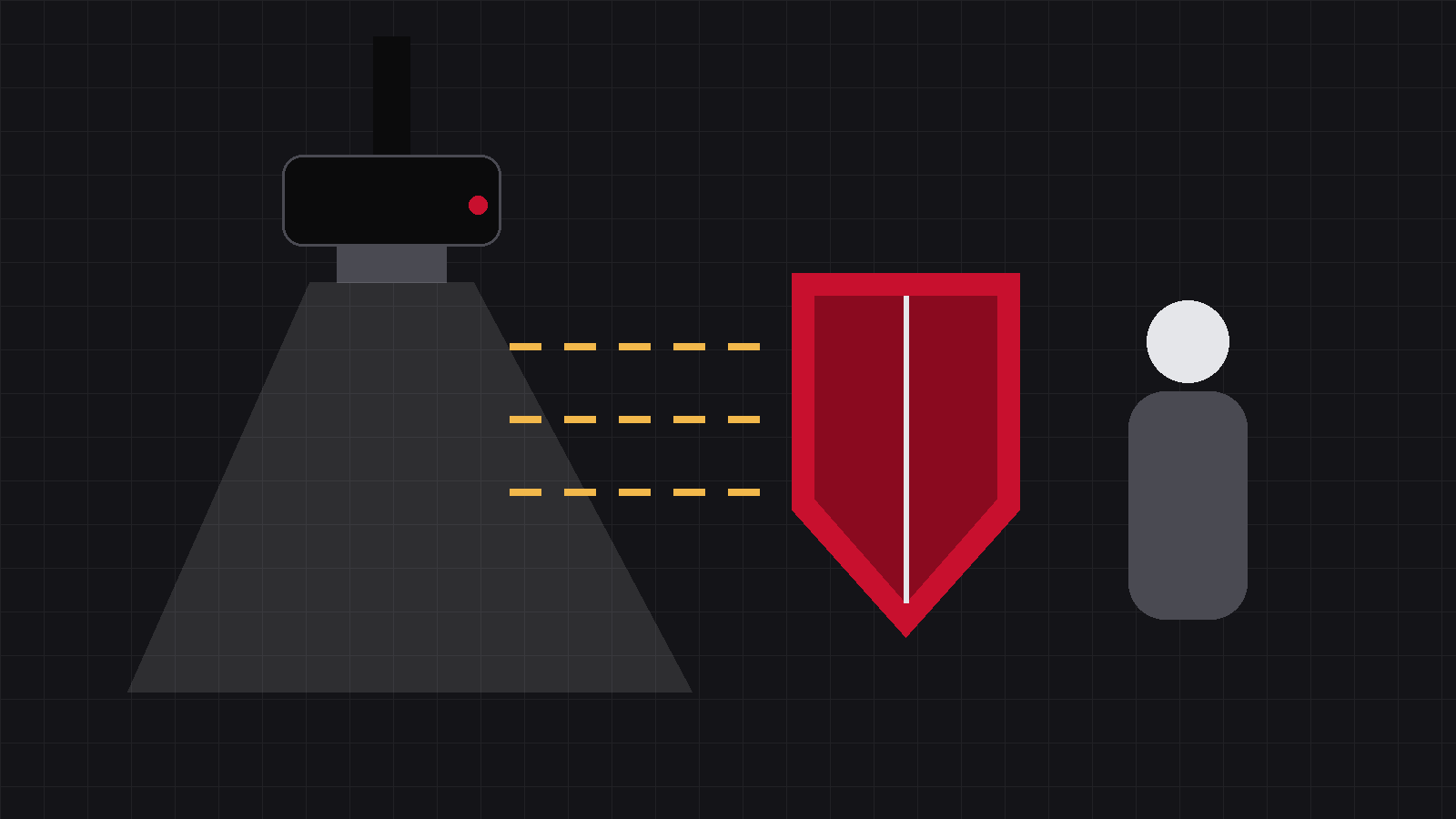
In most veterinary practices, taking a radiograph is a two-person job: one restrains the animal, one presses the hand switch. The person on the switch instinctively steps back towards the door and asks: “Is this far enough?” The short answer first: stepping back works far better than you would guess — but where you stand matters more than how far.
01Why it works: a law of physics
Radiation spreads out from a point in all directions, like light from a lamp. If the brightness on you at 1 metre counts as 1, then at 2 metres it is not halved — it drops to one quarter; at 3 metres, only one ninth is left. Radiation behaves the same way: double the distance, and the dose drops to a quarter. This is the inverse-square law.
That is why “one step back” is the cheapest, most immediate protection in the whole clinic. It costs nothing.
02First, know which X-rays you are actually exposed to
There are two paths in the X-ray room:
The primary beam
The beam that travels straight from the tube to the detector. High energy, clearly directed. It is aimed at the animal — as long as no part of your body is inside the collimated field, the primary beam cannot reach you.
Scattered radiation
The part that “bounces” off the animal after the primary beam strikes it, going in every direction. For people working in the room, this is the path that matters.
Much weaker — and weaker with every step
Scatter is far weaker than the primary beam — the difference is orders of magnitude. Add the inverse-square law on top, and every step back delivers a real reduction.
03“Is one metre outside the door enough?” — split it into three questions
① Are you in the primary beam?
Hands, arms, any part of the body — if it is inside the collimated field, you are no longer “receiving scatter”, you are “receiving the primary beam”, and the difference is orders of magnitude. The person restraining the animal makes this mistake most often: reaching into the field to steady the patient. Use sandbags, ties and positioning devices instead — hands never go into the field.
② How far are you from the animal?
One metre further away means one quarter; two metres further means one ninth. Step back whenever you can — to the very end of the hand-switch cable.
③ Is the door closed?
The X-ray room door is itself shielding. Standing outside with the door closed and standing outside with the door open are two different things.
One more point that is easy to overlook: every notch you tighten the collimator, scatter drops another slice. A tighter field not only gives you a cleaner image — everyone in the room receives less scatter too. That deserves an article of its own later in this series.
Nothing to buy — you can start with the very next radiograph.
One step back, three quarters less.
And hands never go into the field.
Source:The inverse-square law is a law of physics. Scatter intensity depends on kV, field size and patient thickness, so this article keeps scatter strictly qualitative and quotes no specific ratios.
IWA Medical · We build DR systems and write our own core software
Questions about veterinary DR imaging? Technical questions go straight to our engineers.